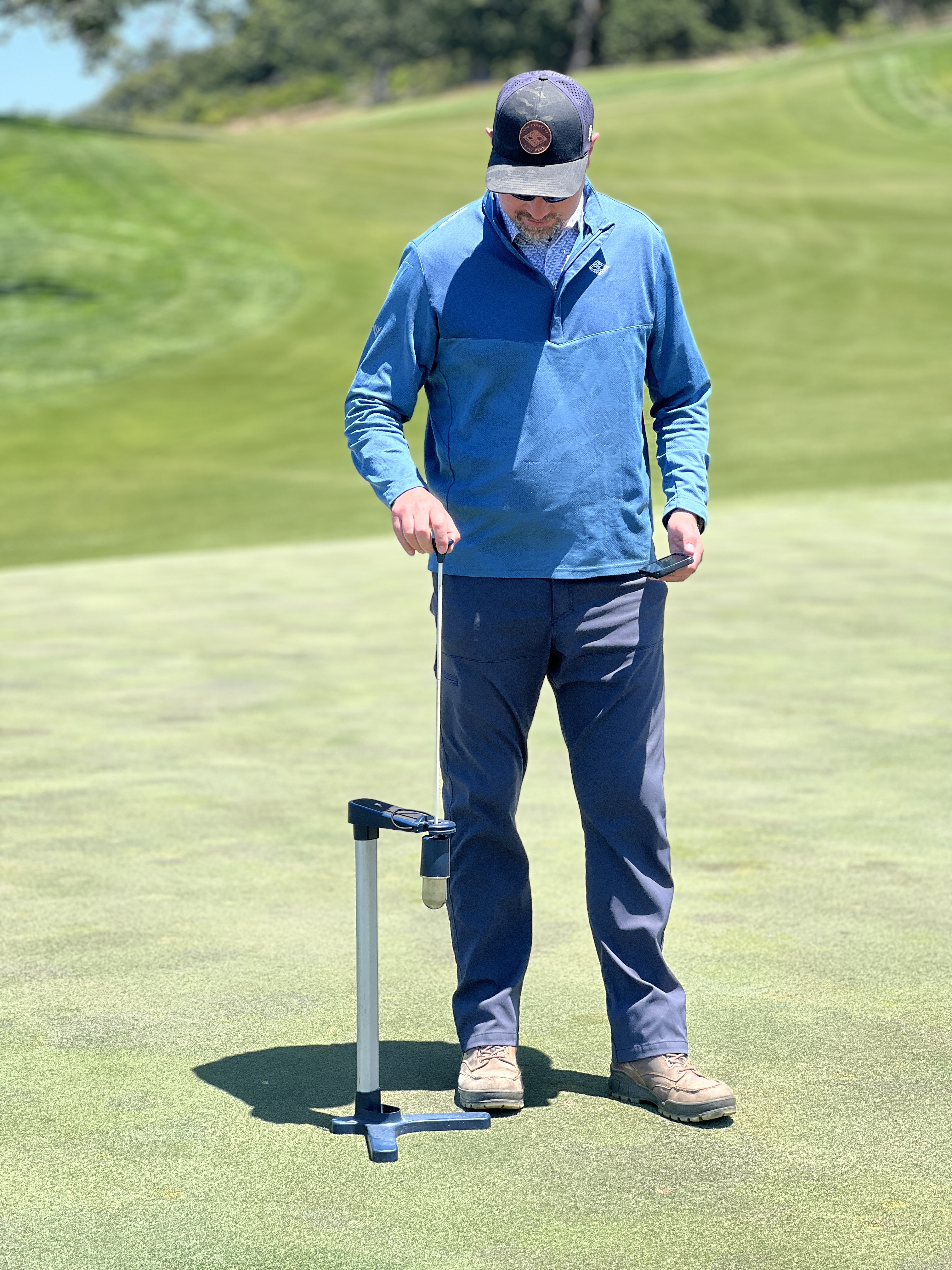
Kyle Butler
Superintendent, The Preserve Golf Club at Santa Lucia Preserve, Carmel, CA
THE INTERVIEW
From the coast to the mountains, Kyle Butler has seen it all in the greater Carmel, CA area. After starting at Pebble Beach Company on The Links at Spanish Bay as an assistant superintendent, Kyle has been the superintendent at the spectacular The Preserve Golf Club at Santa Lucia Preserve for the last seven years. Working in this majestic mountain range has its challenges and Kyle talked to us about how the GS3 ball and DEACON app help him manage the course on a daily basis:
Q: So how long have you had the GS3 ball? And what led you to purchase?
Kyle: This will be our second season. Initially, I thought it was a really neat device, and I was really interested in what that data could provide for us. And with the DEACON app, you’re able to store all the data and share that with the team. I'll be at home, and I’ll wonder what the numbers are on the greens today. And I can see that. So, for those reasons, it was really attractive.
Q: Before GS3, were you involved in data collection?
Kyle: We were taking stimpmeter readings on a handful of greens, clipping volume, and other metrics, and a lot of that was just written down on my phone or on paper. I would compile it, and share it with the greens committee. So, the GS3 ball has really helped with a lot of communication, formal data gathering, and sharing it with those around me.
Q: What do you like most about the ball?
Kyle: The number one thing is the way I can share the data. And I can use it for a greens committee meeting or even talking to a member around the golf course. We've all ran into members who say, well the greens were faster yesterday or I missed the putt on the third green. And I can say, here's the data right here. I love the graphs. I love how you can compare, if you’re mowing and rolling. What did a double roll do for us? And if we mowed three days in a row, what does that look like? Just being able to look at that change over time.
Q: Is there one metric that's more important to you than another in terms of the ball?
Kyle: Smoothness and trueness. But they're all important. They all relate to each other. Normally, the conversation is about green speeds and what are the appropriate green speeds for our golf course and those conversations have been going on forever. By bringing smoothness and trueness readings in, we can look at those also. The importance of those metrics and what they mean to our greens and the playability of the surfaces are significant.
Q: It's obvious that water is at a premium where you’re in California. Do you use the drop fixture to measure firmness?
Kyle: We take firmness readings quite a bit. It’s been our focused area. We've had some pretty good data come from that. We’ve learned that we can run a bit higher with moisture content and still have very, very firm championship greens before a member-guest tournament. And that alleviates stress on me and the staff and also on the green surfaces themselves. And that's been a cool discovery with the GS3 ball.
Q: You worked near the coast and now you're a little west. Are the moisture levels different from where you were to where you are now? Are environmental conditions quite different?
Kyle: We have what I call a true summer up here: we get hot and stay hot. Just driving down the hills, it can be 30 degrees difference. So very different growing conditions here. We're just above coastal influence. We get a little bit of fog and a little bit of that air conditioning from the marine layer, but we are quite different. It's sunny and hot up here in the summer.
Q: Has the GS3 ball helped you in explaining what conditions are like post aeration?
Kyle: It has. Just as far as gathering those numbers and showing what a small tine aeration can do and that the greens are within our target ranges. So, we feel more confident and can educate the membership that we can do these needed practices and not have as much disruption as one might think.
Q: Has the ball changed your maintenance practices at all?
Kyle: The answer is yes and yes in a big way, as in we're trying to produce a phenomenal surface. And now that we have all this data across different areas of the surface, we're using that to make decisions. Do we need to mow more? Do we need a mow and roll tomorrow? Do we need a mow and double roll? Do we need a double cut? It's helping with a lot of that decision making and planning for the next day or the next week because we're using that data to drive our practices for the next day and beyond.
Q: What would you say to someone who might be on the fence about the GS3 ball or DEACON or data collection in general?
Kyle: I'd would say It's a phenomenal tool to help people assess their playing surfaces in a really easy way. It’s a really strong tool to help you communicate those things to the people around you, membership or your GM or whoever it may be. Sharing those numbers in a quick, easy way is pretty priceless.
Q: So, you're seeing a return on investment?
Kyle: Absolutely, without a doubt. It's well ingrained in our practices now. If someone took it away from me, I would certainly miss it quite a bit. It’s definitely worth the money and just a great tool to help superintendents with their communication needs.