Baltusrol Golf Club
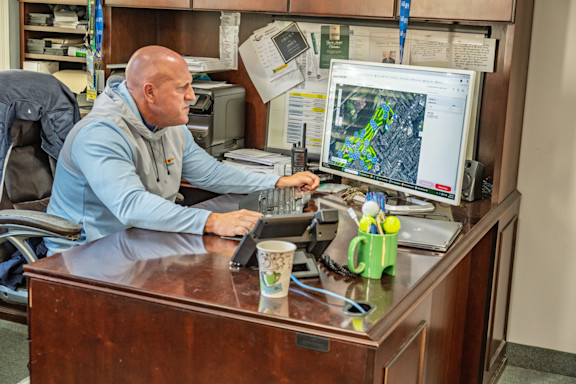
Greg Boring, Director of Grounds
Two major renovations on two courses in five years. And not just any two courses. Two A.W. Tillinghast courses, arguably one of the most influential golf course architects of the 20th century. A daunting task for any superintendent involved in a project like this. But Greg Boring, Director of Grounds at Baltusrol Golf Club, knew exactly what he was getting into when he was hired in 2019.

When he started, Boring had the comfort of knowing that acclaimed architect Gil Hanse would be on board for renovations to both the Lower and Upper Courses at Baltusrol. But he also had another set of eyes helping him: his regional USGA Green Section agronomist.
Prior to joining Baltusrol, Boring had signed up for USGA course consulting visits at the Country Club of Scranton, where he worked for eleven years. “I started working with Elliott Downing at Scranton and we’ve continued the relationship here at Baltusrol,” says Boring. “Elliott knows what I'm trying to provide. I think there's a level of consistency from agronomist to agronomist, where the agronomist knows what type of conditions that the superintendent is trying to provide to his membership. He knows the club.
That's one of the reasons I wanted to bring Elliott down with me and continue the work here, working with me hand in hand at Baltusrol, because he knew what I was looking for.”
There was another benefit to working with a USGA agronomist: discovering the benefits of the GS3 ball. Boring and crew first experienced the GS3 at KPMG Women’s PGA Championship in June of 2023. “I don't think they were readily available at that point in time, but we had one during advance week, as well as the week of the tournament,” says Boring. “For us, it made it a little easier and took all the user error out of it. We have some greens that can be difficult to stimp and the ball helped in that regard.”
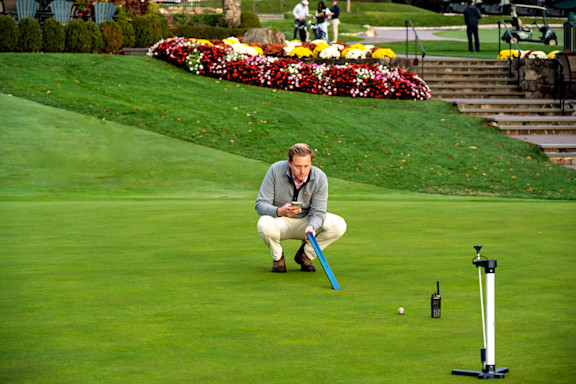
Using a GS3 ball for each course, Boring and crew typically do a data collection in the morning and in the afternoon, daily. While he likes to focus on the smoothness and trueness numbers that the GS3 gives him, there is one metric that means more to him than the others. “For me, it's all about firmness,” he says. “I know if I'm creating a firm surface regardless of what the speed is, chances are it's going to be a smoother surface. It's going to be a truer surface.”
After experiencing the GS3 ball, Boring was ready and willing to try out the new USGA Moisture Meter at Baltusrol. The biggest selling point? The connection both have to the DEACON management system. “Everything was easily uploaded,” he says. “And it’s all on one platform.”
He also likes the accuracy of the Moisture Meter. “I was adamant that I needed consistency from meter to meter,” says Boring. “With the USGA Moisture Meter, we’ve seen a much better consistency from unit to unit, and it's just helped us be more secure with the data that we're collecting on a daily basis.”
The benefit of using USGA course consulting services and their performance tools is a no-brainer for Boring. “The USGA agronomists see so many other clubs,” he says. “If we're struggling with something, they might come in and say, yeah, we're seeing this everywhere. And with the GS3, Moisture Meter, and DEACON, our job is all about making decisions. And I want as much information as I can in order to make that decision. That’s why we use them.”